We will be giving you time in class to work on your dystopia projects this week. On Friday (2/6), we will be watching and discussing Casablanca in class. By the end of the week, we need the following from each group:
A finished version of your script by the start of class Friday (2/6)
A list of the locations where you will be shooting your film
60-90 seconds of edited footage due by end of class Thursday (2/5), uploaded to a computer in the media lab.
Also by Friday (2/6), please read this article from The New York Times on Groundhog Day. In a well written comment, please post a response to the article detailing your own personal religious or philosophical interpretation of the film.
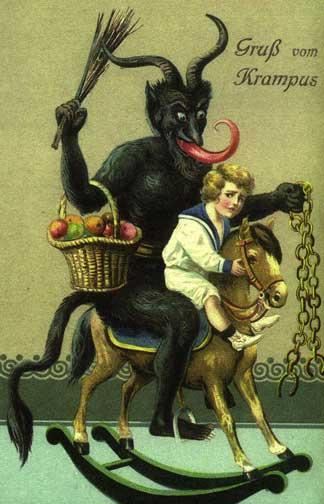
Merry Christmas, ya'll. To the well behaved: enjoy your cheer. To the rest, the cell phone dilly-dalliers: you can't escape Krampus.
Pictured: Krampus and a young Manno twin. Troy?
Yesterday we watched Frank Capra's 1946 holiday masterpiece, It's a Wonderful Life. The film, an initial flop, is now regarded as a classic.
The film is life-affirming and sweet without being syrupy; however, it is not without some measure of darkness. The alternate reality presented to George by Clarence the angel is a vulgar, capitalistic wasteland populated by brothels, bars, and the poor. It's Bedford Falls without its George Bailey.
Pottersville: Ah, business without ethics.
It's not much different than the slums in which the Proles reside in in Nineteen-Eighty-Four.
Yup, it's a dystopia: a wholesome town devastated by unmitigated greed.
As Christmas break approaches, we need to began work on our own dystopia films.
The Twilight Zone (Due Mon. Jan 5th)
To keep you in the proper mindset, please watch all three of the following episodes of TheTwilight Zone.
Select your favorite episode of the three, and describe it in the comment section of this post.
These are excellent examples of small-scale, low production dystopias.
When we return to school on Monday, January 1st, we will be in the library. You and a partner (your choosing) will work to complete a 12 slide treatment for an original dystopia film. The class will vote on the 6 best film pitches (out of 15 groups). 6 groups, led by the two original members, will be randomly generated.
On Friday, January 9th, the 9 slide presentations will be due.
Each presentation should consist of three general sections supplemented by images and discussion.
Characters (3-4 slides)
Dissenter
An "O'Brien" figure: an upper-level party member
A love interest: someone or something that reawakens the humanity in the protagonist
Plot/Conflict (3-4 slides)
Define the "Party"
Define the "Proles"
Explain the conflict--how does the party affect life and in particular, the life of the dissenter
Costumes/Setting (3-4 slides)
Costume ideas: how does the Party affect dress?
Setting: don't think too big; keep it small
Motif, music, symbol, MacGuffin: Incorporate some distinct visual element
As you work, keep Nineteen-Eighty-Four in mind. Your completed film will need to contain an interrogation scene in which the machinations of the Party are explained. Orwell's vision is the most well-defined.
The Twilight Zone provides excellent examples of smaller settings that convey similar themes to Nineteen-Eighty-Four. Remember: Falcon Films are low budget. We have to work within our means. However, setbacks and limitations often spur the most creativity!
Couldn't fix Artoo with a computer in '77.
Kurt Vonnegut is funny. Dystopias can be scary and humorous. However, this is often a delicate line. "Welcome to the Monkey House" also focuses on the repression of human sexuality. This is very Orwellian, and it is something you need to approach delicately in your completed films. Keep it PG.
Just a reminder folks: Applications cannot be submitted via the comment section of this post.
A hard copy must be turned into either me (Clark), Lockwood, or Weisback by Friday, March 14th.
Explain why you want the job you have selected, and why you are qualified. This can be rather informal.
Also, feel free to apply for two or three positions as you may not get your first choice.
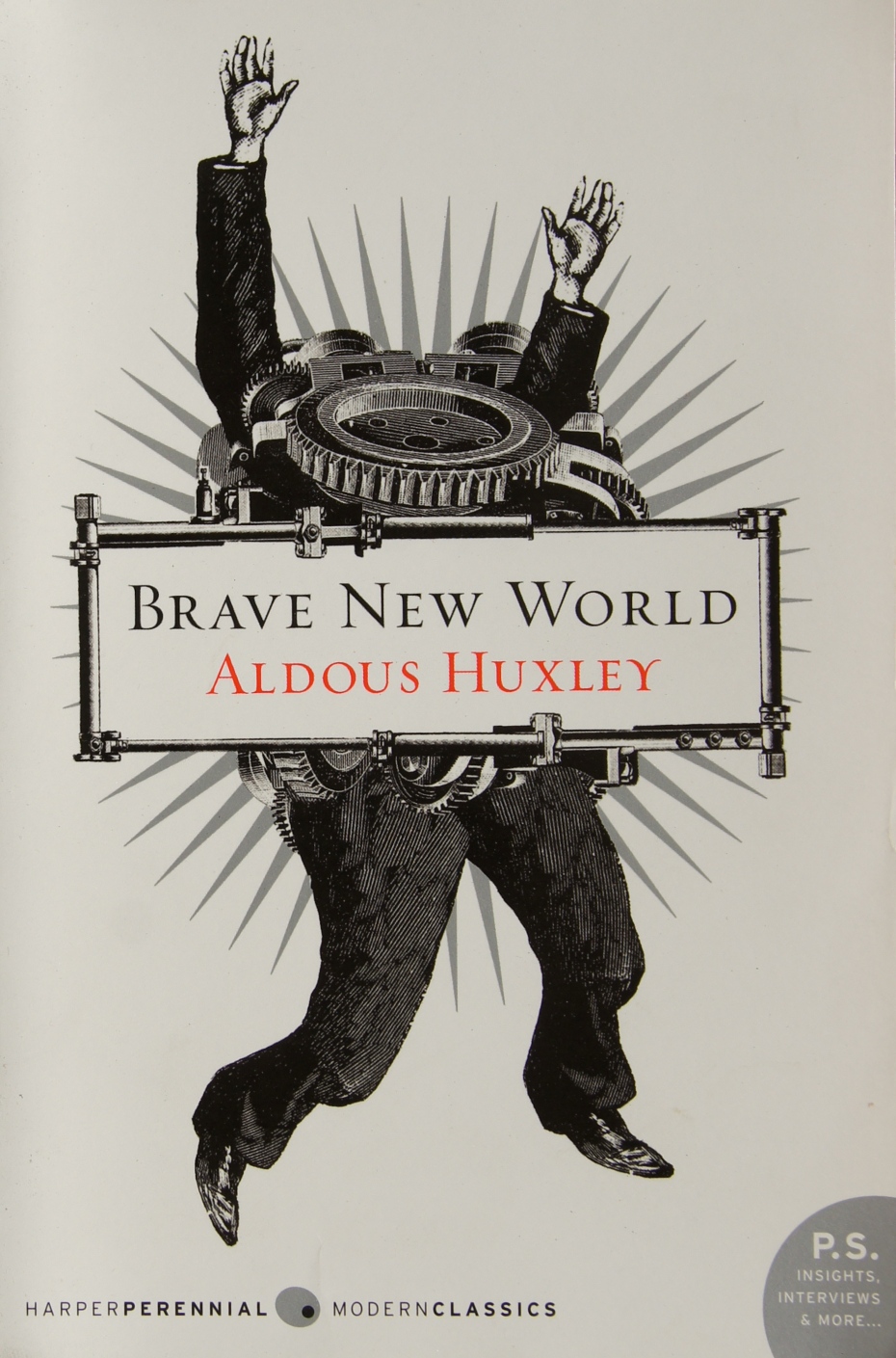
Published in 1932, some 17 years prior to the release of Nineteen Eighty-Four, Brave New World presented British writer Aldous Huxley's disturbing vision of the future of England.
Relax: we are not going to read the novel; however, we are going to discuss its depiction of the future.
Let our man Sparky Sweets get us up to speed:
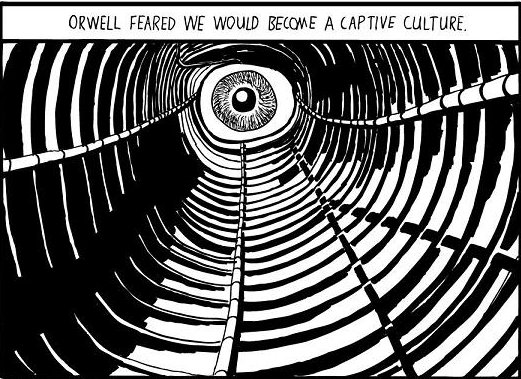
Here is a simple breakdown of the differences between Orwell and Huxley's novels:
Interestingly enough, Huxley was briefly Orwell's French teacher. Perhaps this prompted George to send him a copy of Nineteen Eighty-Four. Huxley, impressed by the novel yet eager for a discussion, sent the following letter to George:
Wrightwood. Cal.
21 October, 1949
Dear Mr. Orwell,
It was very kind of you to tell your publishers to send me a copy of your book. It arrived as I was in the midst of a piece of work that required much reading and consulting of references; and since poor sight makes it necessary for me to ration my reading, I had to wait a long time before being able to embark on Nineteen Eighty-Four.
Agreeing with all that the critics have written of it, I need not tell you, yet once more, how fine and how profoundly important the book is. May I speak instead of the thing with which the book deals ~ the ultimate revolution?
The first hints of a philosophy of the ultimate revolution ~ the revolution which lies beyond politics and economics, and which aims at total subversion of the individual's psychology and physiology ~ are to be found in the Marquis de Sade, who regarded himself as the continuator, the consummator, of Robespierre and Babeuf.
The philosophy of the ruling minority in Nineteen Eighty-Four is a sadism which has been carried to its logical conclusion by going beyond sex and denying it. Whether in actual fact the policy of the boot-on-the-face can go on indefinitely seems doubtful.
My own belief is that the ruling oligarchy will find less arduous and wasteful ways of governing and of satisfying its lust for power, and these ways will resemble those which I described in Brave New World. I have had occasion recently to look into the history of animal magnetism and hypnotism, and have been greatly struck by the way in which, for a hundred and fifty years, the world has refused to take serious cognizance of the discoveries of Mesmer, Braid, Esdaile, and the rest.
Partly because of the prevailing materialism and partly because of prevailing respectability, nineteenth-century philosophers and men of science were not willing to investigate the odder facts of psychology for practical men, such as politicians, soldiers and policemen, to apply in the field of government.
Thanks to the voluntary ignorance of our fathers, the advent of the ultimate revolution was delayed for five or six generations. Another lucky accident was Freud's inability to hypnotize successfully and his consequent disparagement of hypnotism.
This delayed the general application of hypnotism to psychiatry for at least forty years. But now psycho-analysis is being combined with hypnosis; and hypnosis has been made easy and indefinitely extensible through the use of barbiturates, which induce a hypnoid and suggestible state in even the most recalcitrant subjects.
Within the next generation I believe that the world's rulers will discover that infant conditioning and narco-hypnosis are more efficient, as instruments of government, than clubs and prisons, and that the lust for power can be just as completely satisfied by suggesting people into loving their servitude as by flogging and kicking them into obedience.
In other words, I feel that the nightmare of Nineteen Eighty-Four is destined to modulate into the nightmare of a world having more resemblance to that which I imagined in Brave New World.
The change will be brought about as a result of a felt need for increased efficiency. Meanwhile, of course, there may be a large scale biological and atomic war ~ in which case we shall have nightmares of other and scarcely imaginable kinds.
Yes, you: members of the prestigious Film Institute. But the time has come to rise up and dare to portray the dystopian nightmare Oakcrest has become since the arrival of our great "protector," Big Brother.
Hopefully from reading 1984 and watching Metropolis, Blade Runner, The Matrix, V for Vendetta, and Children of Men,you have arrived at the conclusion that artistic expression is the enemy of totalitarian regimes.
Alas, we will combat Big Brother through the means of cinematic expression, a truly collaborative form of art.
"Artists use lies to tell the truth."
_________________________________________________________________________________
Both classes of the Film Institute will be expected to complete a 7-10 minute short film depicting the effects of Big Brother here at Oakcrest High School.
The following is a list of questions that the short films should explore:
Define Big Brother: Who is (s)he? How did (s)he come to power? What does (s)he represent?
Who are the enemies of this newly, Big-Brothered Oakcrest? Do the alliances shift? Explain.
What are the hierarchical classes at Oakcrest? Are there proles? Upper party members? Explain.
How does Oakcrest control thought and expression?
How have the arts been affected? Sports? Curriculum?
What is the state of the Oakcrest media program?
Are students allowed to have interpersonal relationships?
The films must include/portray the following:
A 20 or more page script
A completed storyboard depicting the shots to be used in the film
A "2 Minute Hate"
Narration: Due to the short running time, this is key.
A character must cross Big Brother and pay the price. The consequences and ensuing reprogramming must be depicted.
Appropriate music (Radiohead encouraged. I'll lend you Hail to the Thief if you so desire!)
This project will consist of an on-going, collaborative effort. Each class must select members to fill the following roles:
Director - The director is in "charge" of the film. (S)he supervises the story and oversees the production, making creative decisions that ultimately shape the final product.
Production Designer - The production designer creates the "look" of the film. This job also includes wardrobe selection.
Screenwriter - Although the plot and concept for the film will be collaboratively inspired, these students will be responsible for composing the 20 page script. Improvised dialogue is permitted, but the film must be scripted!
Director of Photography - The DP is responsible for planning the shots used to compose the film. The DP must completed a detailed storyboard prior to filming.
Cameramen - To portray a world in which residents are constantly observed, the films will be shot solely with iPhones. Sideways only; don't forget!
Editor - The editor is responsible for compiling the footage into a smoothly transitioned film. This job also entails the task of creating credits.
Actors - Each member of the group must appear in the film in some way or the other. Don't look directly at the camera.
When is this due? I don't know. We will spend this week brainstorming: reading 1984, discussing the films we have watched, and working on concocting a plot.
The stark and impressive imagery of Fritz Lang's 1927 silent opus, Metropolis, serendipitously syncs with the music of British band, Radiohead. The version of the film we watched yesterday in class was assembled by a graphic designer from Arizona.
The above link will also allow you to watch the film at home if you so desire! Impress your friends! Convey the important message that the mediator between the head and the hands must always be the heart, an idea that directly correlates to your next assignment.
Metropolis is a film that portrays a terrifying imagined future, or in other words, a dystopia. The word dystopia refers to "an imagined place or state in which everything is unpleasant or bad, typically a totalitarian or environmentally degraded one."
In the 20th century, many writers and directors alike envisioned a future plagued by technology and advancement: worlds in which humanity suffered in the wake of new technological discoveries.
In some ways, this idea can be traced back to Mary Shelley's Frankenstein. Life, as created by technology, goes awry, and a demonic monster is birthed by the science of man.
The same thing happens in Metropolis: Rotwang makes a robot, a "maschinenmensch." Chaos ensues.
The scientists in 28 Days Later attempt to cure rage. They discover a "rage" virus, and thanks in part to the good intentions of some animal rights' activists, chaos ensues.
Both films explore the negative effects of intermingling nature and science, and ultimately, both films depict dystopias.
In my mind, both of the aforementioned films can be considered the progeny of Shelley's idea of the "Modern Day Promotheus": Frankenstein's monster.
We will finish our discussion of Frankenstein thusly:
Watch this succint but thorough summary courtesy of our man, Sparky Sweets.
Read an excerpt from Stephen King's "Danse Macabre" in which he explores the enduring legacy of Shelley's creation. He attributes the popularity of the monster to the brilliance of the idea and to the now classic film adaptations. I will distribute copies of the essay in class, today.
Your Task:
Compose a 500+ word essay (3 full, typed pages; double-spaced; size 12 Times New Roman) in which you explore the creature's continued omnipresence.
Support your response with
specific references to films we have watched in class (or films you have watched on your own),
references to the plot of Shelley's Frankenstein (the novel itself),
and references to Stephen King's essay.
Your completed, typed essay must be turned in by Friday, November 15th.
No complaints, please. After all, I could make you read the novel in its entirety, a novel Stephen King refers to as a "rather slow and talky melodrama."