Showing posts with label The Twilight Zone. Show all posts

Tuesday, December 23, 2014

The Dystopia Project

Merry Christmas, ya'll. To the well behaved: enjoy your cheer. To the rest, the cell phone dilly-dalliers: you can't escape Krampus.
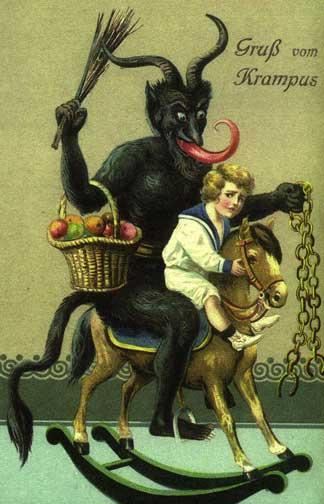
Pictured: Krampus and a young Manno twin. Troy?
Yesterday we watched Frank Capra's 1946 holiday masterpiece, It's a Wonderful Life. The film, an initial flop, is now regarded as a classic.

The film is life-affirming and sweet without being syrupy; however, it is not without some measure of darkness. The alternate reality presented to George by Clarence the angel is a vulgar, capitalistic wasteland populated by brothels, bars, and the poor. It's Bedford Falls without its George Bailey.

Pottersville: Ah, business without ethics.
It's not much different than the slums in which the Proles reside in in Nineteen-Eighty-Four.
Yup, it's a dystopia: a wholesome town devastated by unmitigated greed.

As Christmas break approaches, we need to began work on our own dystopia films.

The Twilight Zone (Due Mon. Jan 5th)
  • To keep you in the proper mindset, please watch all three of the following episodes of The Twilight Zone.
  • Select your favorite episode of the three, and describe it in the comment section of this post. 
    • These are excellent examples of small-scale, low production dystopias.
    • They use writing; not CGI.


"The Obsolete Man"

"The Number 12 Looks Just Like You"

"A Thing About Machines"

http://www.imdb.com/video/imdb/vi232564505

"Welcome to the Monkey House" (Due Mon. Jan. 5th)
  • Read the Kurt Vonnegut short story, "Welcome to the Monkey House."
  • Respond to the accompanying questions.
  • Email the responses to me.

Kurt Vonnegut: "Welcome to the Monkey House"
The questions: Here


Your Films
When we return to school on Monday, January 1st, we will be in the library. You and a partner (your choosing) will work to complete a 12 slide treatment for an original dystopia film. The class will vote on the 6 best film pitches (out of 15 groups). 6 groups, led by the two original members, will be randomly generated.

On Friday, January 9th, the 9 slide presentations will be due.

Each presentation should consist of three general sections supplemented by images and discussion.

Characters (3-4 slides)
  • Dissenter
  • An "O'Brien" figure: an upper-level party member
  • A love interest: someone or something that reawakens the humanity in the protagonist
Plot/Conflict (3-4 slides)
  • Define the "Party"
  • Define the "Proles"
  • Explain the conflict--how does the party affect life and in particular, the life of the dissenter
Costumes/Setting (3-4 slides)
  • Costume ideas: how does the Party affect dress?
  • Setting: don't think too big; keep it small
  • Motif, music, symbol, MacGuffin: Incorporate some distinct visual element
As you work, keep Nineteen-Eighty-Four in mind. Your completed film will need to contain an interrogation scene in which the machinations of the Party are explained. Orwell's vision is the most well-defined.

The Twilight Zone provides excellent examples of smaller settings that convey similar themes to Nineteen-Eighty-Four. Remember: Falcon Films are low budget. We have to work within our means. However, setbacks and limitations often spur the most creativity!
Couldn't fix Artoo with a computer in '77.
Kurt Vonnegut is funny. Dystopias can be scary and humorous. However, this is often a delicate line. "Welcome to the Monkey House" also focuses on the repression of human sexuality. This is very Orwellian, and it is something you need to approach delicately in your completed films. Keep it PG.

Wednesday, March 11, 2009

Robots, Zombies, and A Chicken from Outer Space


While driving a Light Cycle from Tron through the massive landscapes of the internet, I stumbled upon a treasure from the past that I never gave too deep of a look into. Dismounting the cycle, I meander over and picked up a rock which was covered in simple slapstick, a dog, and the Cartoon Network emblem. However there was some shine to this rock and much like Aladdin's lamp, this rock held inside treasures beyond the workings of time and space. With a few rubs I soon found great artistic vision, a dark and comical view on the paranormal, and enthralling story lines. There he stood in front of me, Courage the Cowardly Dog, my newest muse.

For those unfamiliar with this cartoon, here's John R. Dilworth's Golden Globe and Academy Award nominated animated short that started it all, The Chicken from Outer Space.

A major part that makes Courage, Courage is its artist design. Blending a world of cartoon with elements of 3D, such as the chicken's UFO, brings a level of creepiness and other worldliness.
 In many other episodes, vehicles, characters and other elements are created in the 3D format which makes them stand out within this shabby world Courage lives in. Another element of its artistic design, is the color choices. Courage the Cowardly Dog is drawn up much like Watchmen, keeping towards the secondary colors like green, purple, and orange. This ultimately gives the world a tone of it's own. Using secondary colors in a world dominated by primaries, allows the cartoon to look withdrawn from the world we're used to. These two elements allow the slapstick filled cartoon to continue to haunt us during each viewing.

In addition to the artistic vision, the story lines are mixture of Looney Tunes and The Twilight Zone. The opening of each episode, tells us everything we need to know about each character, who never grow, just continue being ignorant about the world they live in (except for Courage). Every episode starts with the conflict being introduced and Courage is then faced with a large amount of slap stick, one liners, and most important paranormal. Most episodes draw from a different seminal piece of work of science fiction or horror. References to Peter Lorre, Sweeney Todd, and The Hunchback of Notre Dame all are used as starting points for stories, however other stories pull ideas out of nowhere, such as an island inhabited completely by bananas or a gerbil vacuum salesman named Doc Gerbil. While many episodes follow similar curves of villain appears, Eustace and Muriel are in danger, and Courage gets beaten to a pulp but manages to save the day, the story stays fresh with the references and many other original ideas. This save the day story line combined with the dark paranormal references and slap stick comedy, creates a haunting tone which leaves you uncomfortable at times. When Courage has been comical brutalized by a Weremole and his teeth are knocked out, are we intended to laugh or feel sorry for our hero?

Courage the Cowardly Dog's greatest strength was it's fearless approach to create a story. No subject or reference was too far for this show. If the story was about foot fungus, then they have the fungus take over Eustace and act like Little Caesar. The Doc Gerbil episode ends with a boat chase dubbed over with operatic music. The show continued to test the bound of the comedic cartoon platform and ended with a haunting story of a dog seemingly living the same day over and over just with a new twisted turn of events. If Nowhere, Kansas isn't hell, I'd fear to find out what is.