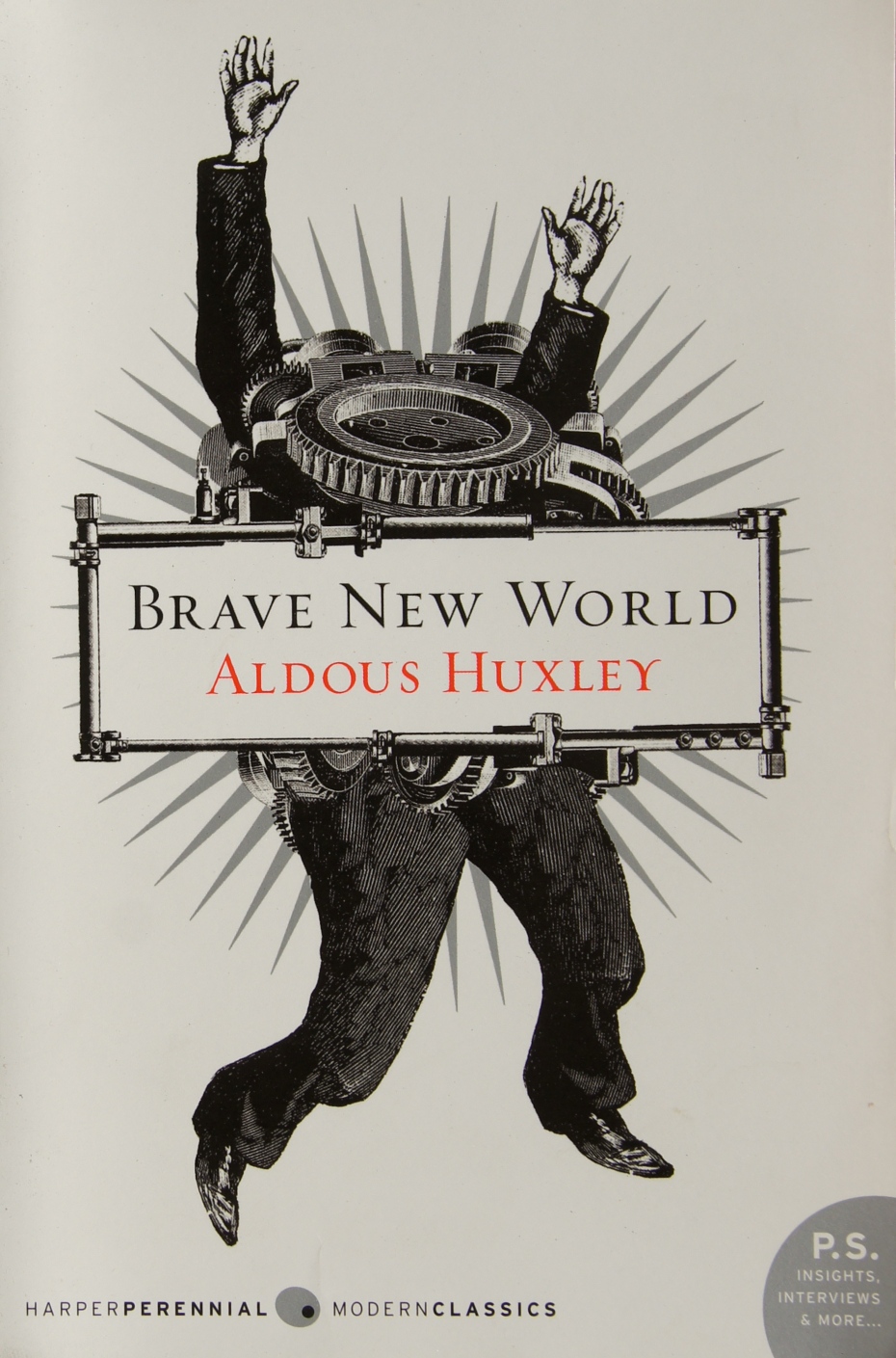
Published in 1932, some 17 years prior to the release of Nineteen Eighty-Four, Brave New World presented British writer Aldous Huxley's disturbing vision of the future of England.
Relax: we are not going to read the novel; however, we are going to discuss its depiction of the future.
Let our man Sparky Sweets get us up to speed:
Here is a simple breakdown of the differences between Orwell and Huxley's novels:
Interestingly enough, Huxley was briefly Orwell's French teacher. Perhaps this prompted George to send him a copy of Nineteen Eighty-Four. Huxley, impressed by the novel yet eager for a discussion, sent the following letter to George:
Wrightwood. Cal.
21 October, 1949
Dear Mr. Orwell,
It was very kind of you to tell your publishers to send me a copy of your book. It arrived as I was in the midst of a piece of work that required much reading and consulting of references; and since poor sight makes it necessary for me to ration my reading, I had to wait a long time before being able to embark on Nineteen Eighty-Four.
Agreeing with all that the critics have written of it, I need not tell you, yet once more, how fine and how profoundly important the book is. May I speak instead of the thing with which the book deals ~ the ultimate revolution?
The first hints of a philosophy of the ultimate revolution ~ the revolution which lies beyond politics and economics, and which aims at total subversion of the individual's psychology and physiology ~ are to be found in the Marquis de Sade, who regarded himself as the continuator, the consummator, of Robespierre and Babeuf.
The philosophy of the ruling minority in Nineteen Eighty-Four is a sadism which has been carried to its logical conclusion by going beyond sex and denying it. Whether in actual fact the policy of the boot-on-the-face can go on indefinitely seems doubtful.
My own belief is that the ruling oligarchy will find less arduous and wasteful ways of governing and of satisfying its lust for power, and these ways will resemble those which I described in Brave New World. I have had occasion recently to look into the history of animal magnetism and hypnotism, and have been greatly struck by the way in which, for a hundred and fifty years, the world has refused to take serious cognizance of the discoveries of Mesmer, Braid, Esdaile, and the rest.
Partly because of the prevailing materialism and partly because of prevailing respectability, nineteenth-century philosophers and men of science were not willing to investigate the odder facts of psychology for practical men, such as politicians, soldiers and policemen, to apply in the field of government.
Thanks to the voluntary ignorance of our fathers, the advent of the ultimate revolution was delayed for five or six generations. Another lucky accident was Freud's inability to hypnotize successfully and his consequent disparagement of hypnotism.
This delayed the general application of hypnotism to psychiatry for at least forty years. But now psycho-analysis is being combined with hypnosis; and hypnosis has been made easy and indefinitely extensible through the use of barbiturates, which induce a hypnoid and suggestible state in even the most recalcitrant subjects.
Within the next generation I believe that the world's rulers will discover that infant conditioning and narco-hypnosis are more efficient, as instruments of government, than clubs and prisons, and that the lust for power can be just as completely satisfied by suggesting people into loving their servitude as by flogging and kicking them into obedience.
In other words, I feel that the nightmare of Nineteen Eighty-Four is destined to modulate into the nightmare of a world having more resemblance to that which I imagined in Brave New World.
The change will be brought about as a result of a felt need for increased efficiency. Meanwhile, of course, there may be a large scale biological and atomic war ~ in which case we shall have nightmares of other and scarcely imaginable kinds.
Yes, you: members of the prestigious Film Institute. But the time has come to rise up and dare to portray the dystopian nightmare Oakcrest has become since the arrival of our great "protector," Big Brother.
Hopefully from reading 1984 and watching Metropolis, Blade Runner, The Matrix, V for Vendetta, and Children of Men,you have arrived at the conclusion that artistic expression is the enemy of totalitarian regimes.
Alas, we will combat Big Brother through the means of cinematic expression, a truly collaborative form of art.
"Artists use lies to tell the truth."
_________________________________________________________________________________
Both classes of the Film Institute will be expected to complete a 7-10 minute short film depicting the effects of Big Brother here at Oakcrest High School.
The following is a list of questions that the short films should explore:
Define Big Brother: Who is (s)he? How did (s)he come to power? What does (s)he represent?
Who are the enemies of this newly, Big-Brothered Oakcrest? Do the alliances shift? Explain.
What are the hierarchical classes at Oakcrest? Are there proles? Upper party members? Explain.
How does Oakcrest control thought and expression?
How have the arts been affected? Sports? Curriculum?
What is the state of the Oakcrest media program?
Are students allowed to have interpersonal relationships?
The films must include/portray the following:
A 20 or more page script
A completed storyboard depicting the shots to be used in the film
A "2 Minute Hate"
Narration: Due to the short running time, this is key.
A character must cross Big Brother and pay the price. The consequences and ensuing reprogramming must be depicted.
Appropriate music (Radiohead encouraged. I'll lend you Hail to the Thief if you so desire!)
This project will consist of an on-going, collaborative effort. Each class must select members to fill the following roles:
Director - The director is in "charge" of the film. (S)he supervises the story and oversees the production, making creative decisions that ultimately shape the final product.
Production Designer - The production designer creates the "look" of the film. This job also includes wardrobe selection.
Screenwriter - Although the plot and concept for the film will be collaboratively inspired, these students will be responsible for composing the 20 page script. Improvised dialogue is permitted, but the film must be scripted!
Director of Photography - The DP is responsible for planning the shots used to compose the film. The DP must completed a detailed storyboard prior to filming.
Cameramen - To portray a world in which residents are constantly observed, the films will be shot solely with iPhones. Sideways only; don't forget!
Editor - The editor is responsible for compiling the footage into a smoothly transitioned film. This job also entails the task of creating credits.
Actors - Each member of the group must appear in the film in some way or the other. Don't look directly at the camera.
When is this due? I don't know. We will spend this week brainstorming: reading 1984, discussing the films we have watched, and working on concocting a plot.